

What Clean Hardwood Floors After You Lift Padding
Hardwood floors add beauty, charm, and warmth to your home but, as well their artful value, ane of their best attributes is that they're easy to clean. Most of the fourth dimension, a quick vacuuming is all they demand.
Every once in a while, though, especially if yous have kids and pets, they require a deep cleaning .
I'm non talking nearly vacuuming for a little longer than usual or wiping them downwardly with your Swiffer. I'm talking about rolling up your sleeves and getting rid of the stains and grime that have built upwards over several months.
So how exactly do y'all deep make clean hardwood floors?
It's actually pretty piece of cake; here are the basic steps:
- Stride 1: Pick up loose clay and grit with a vacuum, microfiber mop, or broom with split tips.
- Pace two: Determine whether your floors are protected with a surface or penetrating end.
- Footstep 3: Pick a hardwood floor cleaner peculiarly designed for your floor finish.
- Footstep four: Spray the cleaner on the floors and mop in the direction of the floorboards.
- Pace v: Remove deep stains, grease, and scuff marks.
Although the process is quite simple, there are important details to know most each step to maximize your efforts and, more importantly, avoid damaging your floors.
To get the full story, keep reading. In this article, I explain footstep-past-pace how to deep make clean hardwood floors. Plus, I teach you how to avoid common cleaning mistakes, how frequently your floors need cleaning, and how to prevent stains in the starting time place.
Use the links beneath to navigate this article:
- Stride ane: Pick Up Loose Clay and Grit
- Step 2: Identify Your Floor Finish
- Step iii: Pick the Right Hardwood Floor Cleaner
- Step 4: Mop in the Direction of the Floorboards
- Step 5: Remove Deep Stains
- Frequency: How Often Should Yous Deep Clean Hardwood Floors?
- Preventative Measures: How to Minimize Cleaning Frequency
- Deep Cleaning Tips to Remember
Footstep 1: Choice Up Loose Clay and Dust
The first and easiest pace in the process is to remove loose dirt and dust from your floors. The best tool for this pace is a vacuum with a floor attachment that has soft bristles.
Avert using a vacuum with an aggressive beater bar with difficult beard. A beater bar is a cylinder-shaped bar within the vacuum head that spins apace to lift dirt embedded deep in high-pile carpets. Large upright-style vacuums designed for carpets typically have ultra-aggressive beater bars, and well-nigh of them will scratch hardwood floors unless the vacuum head is designed specifically for hard surfaces.
If you're thinking about investing in a new vacuum, I recently published this article comparing the elevation vacuums for hardwood floors and surface area rugs. Spoiler: I highly recommend canister-style vacuums, and the all-time one you can buy is the Dyson Ball Multi Floor Canister Vacuum (also helpful: my in-depth comparing of Bissell vs. Dyson vacuums). It'southward super powerful and comes with plenty of attachments for hardwood floors.
If your current vacuum doesn't have an attachment for wood floors, the next best option is to use a floor mop that has a detachable microfiber head like this one. The microfibers act equally a vacuum for particles of grit while other mops and sponges with thicker fibers button dust forth but don't pick information technology up.
To get the best results, fill up a spray bottle with water and give your floors a very lite spritz before wiping them immediately with the microfiber mop. The water will attract dust and dirt particles, and the microfiber cloth will blot the water.
If y'all don't accept a vacuum safe for hardwood floors or a microfiber mop, sweep upward the loose dirt and dust with a broom that has fine bristles and exploded/separate tips (similar this) . The fine bristles are small enough to option up dust and dirt sandwiched betwixt the floorboards. Some brooms have thicker bristles that won't pick upwards grit as well and could scratch your floor.
Step ii: Identify Your Flooring Finish
Now that you've cleared out the loose clay and grit, it's time to decide the type of finish on your floors. This step is vital because floor cleaning products are designed for item finishes, and using the wrong product could atomic number 82 to astringent, and in some cases irreversible, damage.
The good news is that you don't have to be a home comeback guru to figure out which type of finish is on your floors. Let me explain in straightforward terms.
There are ii categories of floor finishes; surface and penetrating.
Surface Finishes
Surface finishes are the nigh common type of residential wood floor finish. Some examples of finishes in this category are polyurethane, oil-based urethane, water-based urethane, and moisture-cured urethane. They are practical on top of stained wood floors to provide a layer of protection and requite them a glossy, semi-gloss, or satin look.
Surface finishes preclude h2o and other liquids from arresting into the flooring, making it like shooting fish in a barrel to wipe up spills. This type of finish is and so popular because information technology makes floors super durable and piece of cake to maintain.
Penetrating Finishes
Rather than creating a bulwark on top similar surface finishes do, penetrating finishes (besides known as oil finishes) absorb deep into the fibers of the forest to oxidize and harden it from the inside out. Most floors with penetrating finishes are coated with a layer of floor wax, which adds some surface protection but not nearly equally much as a surface end.
Floors with penetrating finishes are very prone to water harm. Since the end and wax blanket doesn't completely seal the surface, liquids tin can seep into the wood, causing information technology to expand and warp.
Since floors with penetrating finishes require more than maintenance, they are much less common than surface finishes, particularly in newer homes. However, earlier surface finishes came well-nigh in the 1920s, oiled and waxed wood floors were the just choice. If your home was congenital before 1920, there's a decent chance your floors have a penetrating end.
Now that you sympathise the two types of finishes, how practice you determine which finish is on your floor? In that location are a couple of methods; the h2o method and the scraping method.
- Water Method: Pour a small corporeality of water on your floor. If the water pools upwardly, y'all have a surface terminate. If it absorbs quickly into the wood, you have a penetrating finish.
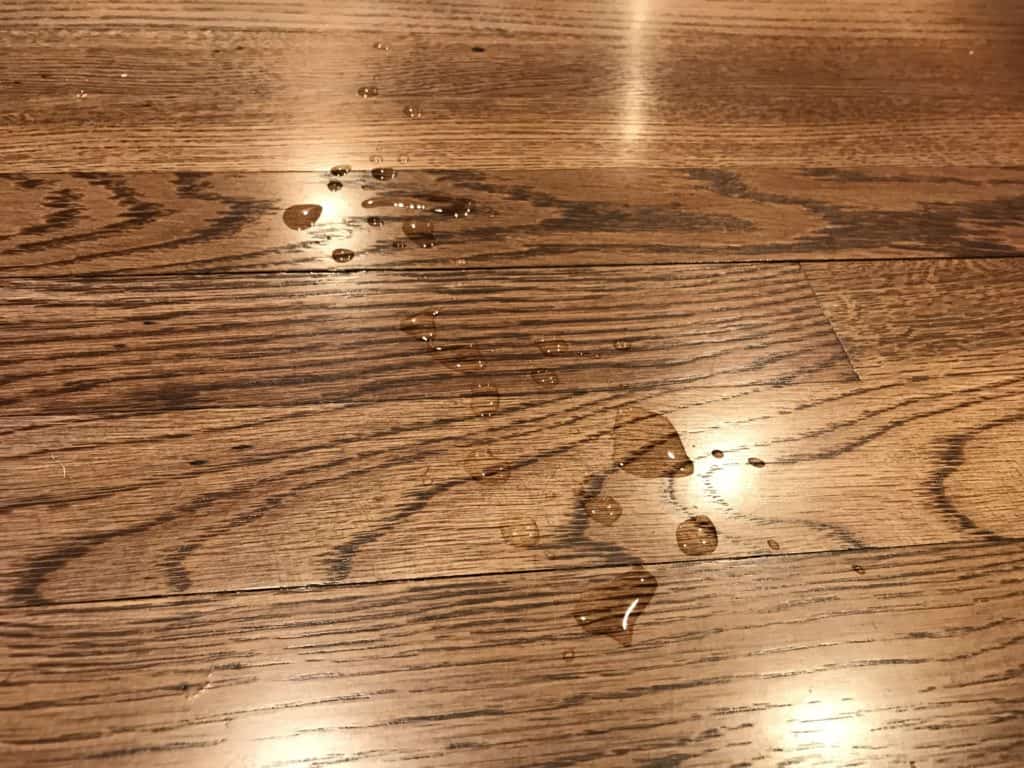
- Scraping Method : Run the edge of a dull pocketknife over a tiny area of the floor. If you're able to scrape a transparent material off the floor, it'south a surface finish. If the floor smudges but no transparent materials scrape off, it's a penetrating finish.

Step 3: Choice the Correct Hardwood Flooring Cleaner
Now that you've identified your floor cease, the next step is to cull the advisable hardwood floor cleaner.
Floors Protected By Surface Finishes
Surface finishes don't permit water to penetrate, and then information technology'southward safety to use near water-based cleaning solutions.
The production I recommend for floors with surface finishes is Bona Hardwood Flooring Cleaner (see on Amazon). It comes in a spray bottle, making it easy to use while keeping the amount of moisture in cheque. Y'all can also buy a larger tank to refill information technology.

To learn more almost why I recommend Bona Hardwood Floor Cleaner, check out our in-depth review that covers how to employ it, what it's made of, it's key benefits, what customers complain about the most.
Alternatively, Bona makes a neat microfiber mop that comes with their cleaner and spray functionality congenital-in. All you lot have to do is pull the trigger below the handle to moisture the floor equally yous mop. Information technology's super popular and is very affordable on Amazon .
When it comes to h2o-based woods floor cleaners, there are so many options. Yous tin salve money buying generic brands, but I typically choose Bona products since they're a trusted make that has been completely dedicated to the installation, renovation, maintenance, and intendance of wood floors since 1919 .
Bona water-based woods floor cleaners are incredibly effective and have very depression VOC emissions making them not simply prophylactic for your floors but likewise safety for y'all. I've talked to many unaffiliated floor experts over the past several years, and eight out of 10 of them recommend Bona products.
If you're not a fan of Bona, Blackness Diamond Stoneworks Wood & Laminate Flooring Cleaner is another groovy water-based cleaner that's very affordable and gets excellent reviews. Similar I mentioned, there are dozens of others if you browse the cleaning alley at whatsoever home improvement store.
Y'all tin't go wrong with either of these especially formulated cleaners, simply yous tin can go wrong by trying to develop a solution of your own. Many blogs will tell y'all to grab a bucket and mix h2o and vinegar , or water and lemon juice, water and bleach, or even water and tea bags—I've read information technology all.
What they don't tell you is that the acid in these homemade solutions volition suspension downward the top layer of sealer, allowing moisture to absorb into the wood. When wet gets in, the forest expands and begins to warp—not good.
The tricky part is that your flooring may look cracking after cleaning it with water and vinegar/lemon/tea one time, but experiments take shown that repeated employ will dethrone the finish and atomic number 82 to severe impairment.
While they sound like great "hacks," your hardwood floors are too important and frankly as well valuable to risk information technology. Spend the $15 or so and get a cleaner that will get the job washed without the chance.
Floors Protected Past Penetrating Finishes
Since floors protected past a penetrating stop are even more susceptible to water harm than floors with surface finishes, use only pH-neutral cleaners specifically designed for penetrating/oil-based finishes. Avert all water-based flooring cleaners as those will speedily absorb into the forest and lead to irreversible harm.
The best product on the market is the Bona Professional Series Natural Oil Hardwood Floor Cleaner (see on Amazon). Its solvents and surfactants are specially formulated for hardwood floors treated with penetrating oil finishes. It's not only rubber for your floors, but it'south as well non-toxic, non-combustible, biodegradable, and GREENGUARD Children and Schools Certified, making it rubber for yous and your family. For more details, check out this product'south technical datasheet.
Pace 4: Mop in the Direction of the Floorboards
Now that yous've removed the grit and dirt, identified the end, and gathered the proper cleaning solutions, information technology's fourth dimension to get cleaning.
For surface-finished floors, spray the water-based hardwood floor cleaner of your choice on your floors and wipe it immediately with a microfiber cloth or floor mop with a microfiber cloth caput. You do not need to mix the cleaner with water; the cleaner is designed to work on its ain. As well, information technology comes in a spray bottle to limit the amount of moisture on your floors.
If you don't have a mop with a microfiber head, you tin buy ane on Amazon ( they're very inexpensive ), or you can utilize a regular sponge mop. I recommend microfiber because it volition attract and absorb clay and crud amend than annihilation else.

The process is the aforementioned for penetrating surfaces, merely instead of spraying a h2o-based cleaner, spray the cleaner specially designed for penetrating finishes.
Regardless of the blazon of finish, it's important to mop in the management of the floorboards. Doing so prevents streaking and allows the fibers of the mop to pick up dirt and crud that's wedged between the floorboards.
If you lot take annihilation away from this article, please accept this: water and wood are natural enemies.
Exposing penetrating-finished wood floors to water is a definite no-no. But, fifty-fifty floors protected with surface finish tin become damaged when excess water leaks betwixt the floorboards. Sure, you might get abroad with wet-mopping your floors a few times, simply eventually, moisture will absorb into the wood.
If you forgo my communication to utilise a spray-and-wipe cleaning solution and instead use a mop and bucket method, I strongly urge you to ring the mop out as much as possible and brand sure information technology'south barely damp when you wipe the flooring. There'due south no reason always to soak your floor with puddles of water; it's a recipe for disaster.
Lesser line—there'due south a reason that specially formulated floor cleaners come in a spray canteen. If you lot use the correct cleaner, your floors only need a calorie-free mist.
Step five: Remove Deep Stains
The 5th, and last, pace is to tackle those scuffs and stains that remain on your hardwoods after mopping.
Every stain is a little scrap different, and and then are techniques necessary to remove them. Hither's a listing of the most common stains and tips on how to get rid of them apace and safely.
Note: The techniques I'm almost to describe are for treating stains on wood floors with surface finishes (polyurethane and urethane). Since floors with penetrating finishes are so susceptible to impairment from h2o and water-based products, the best way to treat stains on them is to use a specially formulated spot remover. The best one, by far, is the Woca Denmark Spot Remover . All you accept to do is spray it on any stain (wine, coffee, water, pet mess, etc.), allow it dissolve the stain for about 15 minutes, and wipe it with a slightly damp cloth. After you lot've removed the stain, you might need to use a new glaze of wax or oil for added protection.
Scuff Marks
Walking with rubber-soled shoes or dragging furniture across your hardwoods will cause cruddy scuff marks. Fortunately, there are a handful of easy means to get rid of them.
The easiest mode to clean scuff marks is to erase them with an eraser (yup, a regular pencil eraser). Just rub the eraser firmly across the scuff marks and sweep abroad whatever of the remaining eraser shavings.
Another easy way to clean scuff marks is to rub them with a lawn tennis ball. If large areas are scuffed up, cut a hole in a lawn tennis ball and attach it to a broomstick, and then you don't have to bend over.
If neither of those ii methods does the fox, mix a little blistering soda in h2o, dab a clean towel or the Mr. Clean Magic Eraser in the mixture, and gently rub scuff marks out of the floor. Dry the area immediately after.
Oil and Grease
To go rid of grease and oil stains, mix a few dashes of dish soap with water and use a cloth to rub the stains gently in a circular motion. Surfactants in dish soap break down the molecules in grease and loosen it from the surface of your floor, merely like they do on messy dishes.
For stubborn grease stains, put a clean textile over the stain and identify an fe on top of the cloth and turn the iron to medium oestrus. The steam from the iron will elevator the grease into the cloth. Prolonged estrus exposure can harm your floor finish, and so only use the atomic number 26 for a minute.
Paint
Fifty-fifty if you protect your floors while painting, a driblet or two volition inevitably sneak past the drib textile. When this happens, rub the paint with a clammy microfiber cloth. If that doesn't work, rub it with a cloth dipped in rubbing alcohol. Wearable gloves and avoid topical contact as the alcohol tin can irritate your skin.
Pet Stains
Mix a solution of 1 office white vinegar and four parts water. Never use a water/vinegar solution with more 25% vinegar. Every bit I mentioned earlier, prolonged exposure to the acid in vinegar can damage your floor, then 'non plenty' is always improve than 'too much.'
Dip a textile in the water/vinegar solution and scrub the stained area for a few minutes. Later you dry the area, sprinkle blistering soda on it and permit that sit for a couple of hours. The baking soda will absorb and deodorize the nasty smell.
Finally, clean upwardly the blistering soda with a clammy cloth and dry the area over again.
If that doesn't work and you all the same have dark stains on your wood floors, place a few paper towels over the stains and spray them with a 3% hydrogen peroxide solution.
Let the moist newspaper towels sit on the stains overnight. In the morn, remove the paper towels and cheque the stains. If yous run into some improvement, but the stains are still nowadays, repeat the process.
Every bit you tin see in this quick video, sometimes it takes several nights to remove the stains completely.
Water Stains
Water stains are common on hardwood floors, and the biggest culprits are potted plants. Most people overwater their plants and don't realize they are leaking out the lesser until information technology's too late.
If you notice water staining on your floors, first try wiping it with a slightly damp cloth. If the water hasn't penetrated the surface of the floor, the stain should wipe correct off.
If that doesn't work, place a clean cloth over the stain. Take a hot clothes iron with the steam setting off and rub it over the fabric for several minutes, keeping the iron in constant motility. The rut from the iron should evaporate the wet that'south embedded into the wood and elevator the stain out.
If this doesn't work, your last resort is to lightly sand the area until the stain is gone and reseal information technology with a surface finish. This process is a lilliputian more involved, so I'd highly recommend consulting with a flooring expert ( get a free quote from i on HomeAdvisor.com ), especially if the stain is more pregnant than a few inches
Chewing Gum
To remove chewing mucilage that's stuck to your floor, put a handful of ice cubes in a plastic bag and hold it against the gum until it turns rock-difficult. One time common cold and hard, you tin can hands chip off the gum with a plastic knife or any other flat tool.
Sticky Residue
Tape and other adhesive materials tin leave a sticky residue on your hardwood floors. When this happens, dip a microfiber cloth or Mr. Clean Magic Eraser sponge in a 4 to one water/vinegar solution and gently rub out the balance.
If that doesn't exercise the trick, pick up some Goo Gone Pro-Power Spray Gel on Amazon . Goo Gone is especially formulated to clean up glutinous messes (or Goo) while leaving the surfaces, in this case, your floor, completely unharmed. Spray it on the residue, let it sit for v minutes, then wipe it off with a damp cloth. Another great product to attempt is Goof Off. It'southward a bit more than potent than Goo Gone, so yous need to be cautious and test it in a small area first. Larn more in this comparison of Goo Gone vs. Goof Off.
Wax
In this recent article, I comprehend four simple means to make clean wax off wood floors and article of furniture. If y'all have a significant wax spill or stain on your woods floors, I highly recommend reading that commodity in its entirety. Just, if you lot don't have the time, here'southward a quick summary.
The simplest way to clean wax from your floors is to gently scrape it off with a plastic utensil, spatula, or credit card. This method works for minor areas, but y'all need to be conscientious not to scratch the woods.
For more substantial waxy messes, I recommend the Oestrus and Wipe method.
In this method, you utilise heat with either a pilus dryer or wearable iron (on the lowest setting) to loosen the wax.
If you use a pilus dryer, wipe the wax with a clean cloth when information technology becomes soft.
If y'all use an iron, identify several paper towels on the wax and a washcloth on top of the paper towels. Press the iron (no steam) on the washcloth in v-2nd increments. Every bit the wax melts, it will absorb up into the paper towels. You lot may need to replace the paper towels throughout the procedure, especially if you have a major area to clean.
Frequency: How Oftentimes Should You Deep Clean Hardwood Floors?
Keeping hardwood floors clean and beautiful isn't a complicated process; y'all just need to stay on pinnacle of information technology. Here's the cleaning and maintenance schedule that the National Wood Flooring Clan recommends:
- Every Day: Remove dirt and grit by sweeping or grit mopping.
- Every Week: Vacuum using a woods floor attachment that won't cause scratches.
- Every Calendar month: Perform a deep cleaning . Mop with a floor cleaner designed for the finish on your detail floors and spot-treat stains.
- Every 3 to 5 Years: Add a fresh glaze of terminate. Applying a new coat of terminate volition restore the look and extend the life of your floors and is a much cheaper alternative to completely refinishing. Speaking of which…
- Every xxx Years: Completely sand down, re-stain, and refinish your floors. You only need to do this if your floors become extremely damaged or worn out from decades of abuse. The total toll will depend on where yous live and the size of your home, but you can wait to pay between $one and $five per foursquare foot.
Preventative Measures: How to Minimize Cleaning Frequency
Hardwood floors don't demand to exist cleaned as often if you take some simple preventative measures to limit your floors' exposure to dirt, dust, and stains. Here's what you lot tin can do:
- Shoes Off: Take your shoes off when y'all enter the business firm. Even if your shoes are clean, the safety or hard soles will wearable on your floors over fourth dimension, causing them to dull. If you're serious about preserving your floors and want to clean as infrequently every bit possible, accept off your shoes.
- Floor Mats: Place floor mats direct outside and inside external doors and in high traffic areas like near the kitchen sink and at the lesser of the stairs. This anti-fatigue mat is fantastic to stand on while your doing dishes. Not only will it protect your flooring from spills, but it will also stick to the floor and prevent you from slipping.
- Area Rugs: Put surface area rugs under furniture, especially tables and couches where you and your family have meals and snacks.
- Piece of furniture Pads: Stick soft pads under the legs of your furniture to preclude scratches and marks on the flooring.
Deep Cleaning Tips to Remember
Deep cleaning hardwood floors is a elementary procedure, but there are a few key things to go along in mind.
- Soft Bristles: Vacuum dust and dirt with a soft bristle castor. Upright vacuums with ambitious beater bars will scratch your floors.
- Specialized Cleaning Products: Utilise a cleaner designed for the specific finish on your floors. Floors with surface and penetrating finished require different care. Before you apply cleaning solutions, make sure you understand what blazon of finish is on your floor.
- Water and Wood Don't Mix: Stick to cleaners designed specifically for hardwood floors. Utilise them with a spray canteen to limit the amount of wet on your floors.
- Avoid Homemade Cleaning Solutions: Never use a bootleg solution of h2o and vinegar/lemon/tea. Over time, the acid levels in vinegar, lemon, and tea will break downwards the finish and pb to permanent impairment.
- Make clean in the Direction of the Floorboards: This allows the vacuum or mop head to clean clay and grime that's built upward between the floorboards.
- Never Use a Steamer on Hardwood Floors: Steamers work great for some surfaces similar tile, but the National Wood Flooring Association says to avoid them on hardwoods because they betrayal the wood to excessive heat and wet. The heat and moisture crusade the wood to expand and contract chop-chop, leading to warping, cupping, and long term damage.
Tell United states What You Think
Exercise yous know of whatever better methods for deep cleaning hardwood floors? Take you tried any products that piece of work well? Go out a comment below; we'd dearest to hear your feedback.
If yous found this article helpful, y'all should also cheque out:
- Is It Safe to Clean Hardwood Floors With Vinegar? (Quick Guide)
- How to Deep Clean Tile Floors: 6 Elementary Steps
- The Ultimate Firm Cleaning Checklist (Printable)
- How to Make clean a Physical Basement Flooring (6 DIY Methods)
- Rejuvenate Floor Cleaner and Restorer Review: Does It Really Work?
- Bona Hardwood Floor Cleaner (The Ultimate Review)
- Did Rejuvenate Ruin Your Floors? Why It Happened & How to Fix It
- The Best Vacuums for Hardwood Floors and Area Rugs
- Goo Gone vs. Goof Off: Which Adhesive Remover Is Improve?
- 4 Cheaper Alternatives to Dyson Vacuums
- Bona vs. Swiffer: Which Floor Mop Is the Best?
- Rejuvenate vs. Bona: Which Floor Cleaner and Polish Is the Best?
- The Ultimate Home Maintenance Checklist (Printable)
- What Cleaning Products Contain Ammonia? (19 Examples)
- Is a Fundamental Vacuum Organization Worth It? (Pros & Cons)

Source: https://prudentreviews.com/how-to-deep-clean-hardwood-floors/
Posted by: kerrgamen1995.blogspot.com
0 Response to "What Clean Hardwood Floors After You Lift Padding"
Post a Comment